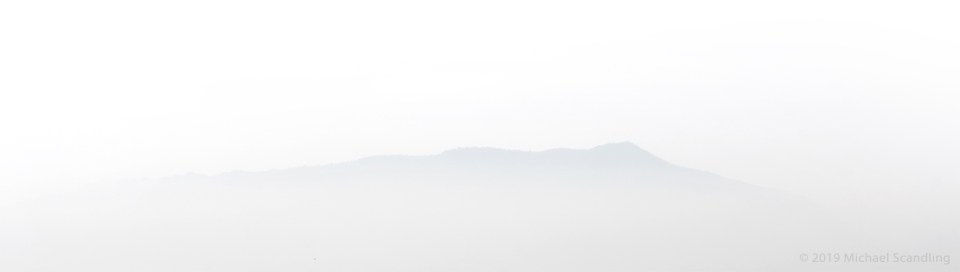
Enveloped in fog.
(Nikon D500; Nikon 28-300mm f/3.5-5.6G ED VR zoom. RAW processing in DxO PhotoLab 2.2; final editing in Adobe Photoshop.)
Enveloped in fog.
(Nikon D500; Nikon 28-300mm f/3.5-5.6G ED VR zoom. RAW processing in DxO PhotoLab 2.2; final editing in Adobe Photoshop.)
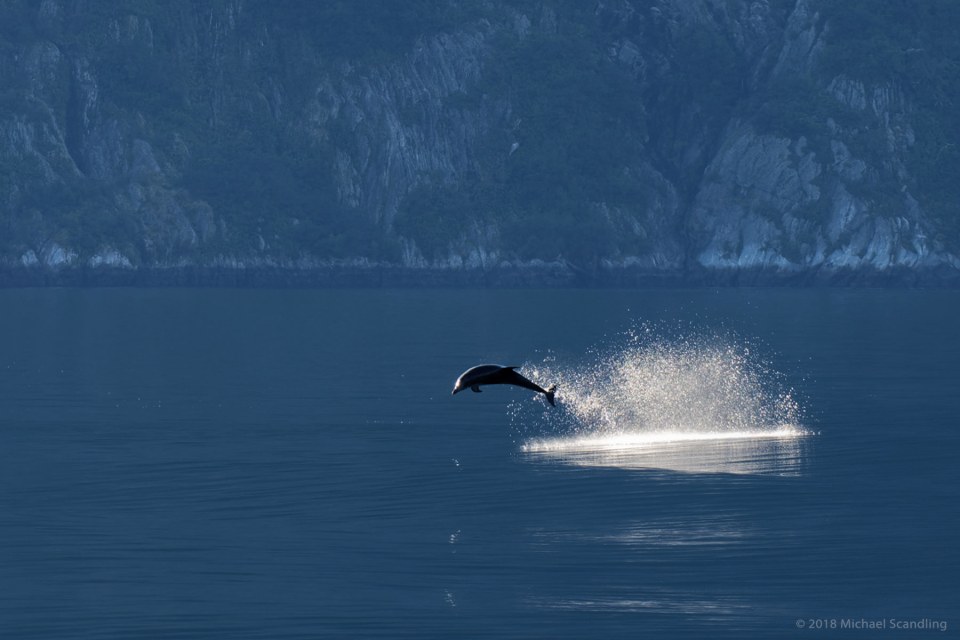
June 20, 2018; Doubtful Sound, South Island, New Zealand. It was a beautiful day. First day of winter in the Southern Hemisphere. Bright sun. Not a cloud in the sky. Gorgeous. The air was crisp. Clean. Cold.
Except this was our one and only day to photograph one of the most dramatic fjords in New Zealand. We wanted clouds. Mist. Fog. Dark dusky drama. Rain squalls. Rainbows. We got none of it. Mother Nature served up sunshine. What was she thinking?
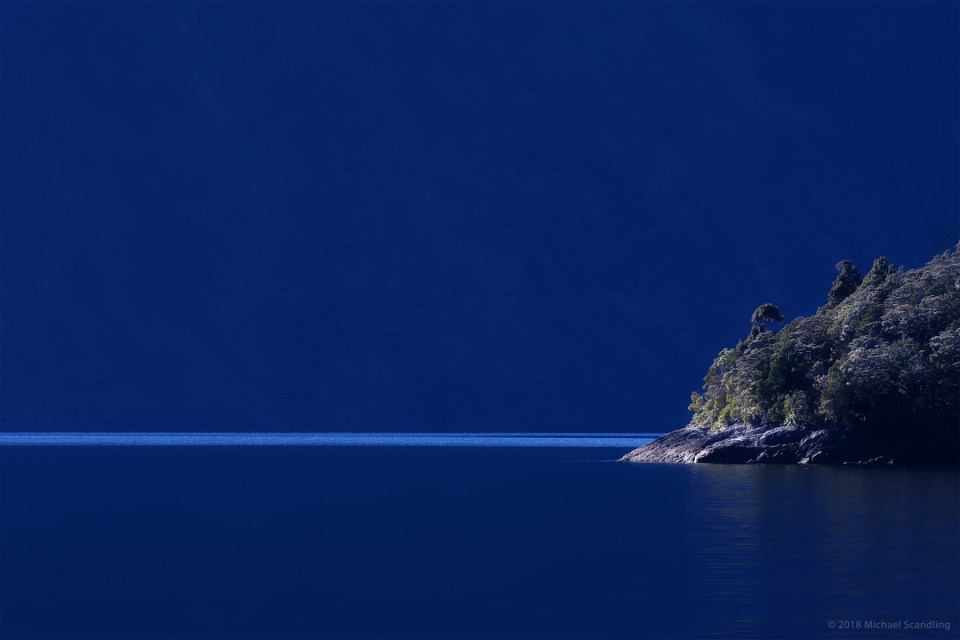
She did provide the makings of one good sea/landscape — appropriately deep blue. See my last blog post.
And now here’s the rest of the story:
Not more than a few minutes later exploded a dolphin, the low sun adding a tiny touch of gold to each lens droplet of the water burst. Up. Click. Gone.
And then it was quiet again.
(Nikon D500; Nikon 200-500mm f/5.6 ED VR zoom. RAW processing in DxO PhotoLab; final editing in Adobe Photoshop.)
(Nikon D500, Nikon 200-500mm f/5.6 ED VR zoom. RAW processing in DxO PhotoLab, final editing in Adobe Photoshop.)
More fine-art photography: www.amagaphoto.com

February 2019. My back yard and my computer. Every year there are plum blossoms in my yard. Every year — in homage to Japanese art — I photograph them, searching for The One. Over the past few weeks, many gigabytes died on this search.
This blossom? That one? One blossom? Many? High-key? Low-key? Simple background? Mottled background? High contrast? Low contrast? Saturated? Muted? On and on and on and on. . .
Images fell like so many petals.
And then a couple weeks ago while running errands on a Saturday afternoon I got caught up in a story on the radio about the unconventional success of Trader Joe’s. Turns out that one of the many reasons for their success is that while they may seem to offer a lot of choice, they don’t. Too much choice leads to indecision and that leads to no sale. Hmmmm. . .
Back to the blossoms. KISS. Keep it simple, Scandling. All the rain we’ve been having means there are no perfect specimens. Get over it. But every single image in past years has been horizontal and this very-good-but-not-perfect one is vertical. Good. Tradition is over-rated. Everything else just fell into place.
And there you are.
(Nikon D500. Tamron 100-400 F/4.5-6.3 Di VC USD. RAW processing in DxO PhotoLab 2. Final editing in Photoshop.)
More fine-art photography: www.amagaphoto.com

July 7, 2002. Bay of Fundy. My love of symmetry around a horizontal line goes way back. In fact, it goes much earlier than this. But this is my first satisfactory rendition using a digital camera.
The camera was a Canon G2. Its resolution was a whopping four megapixels and the 34-102mm lens was not wide enough to capture the whole view — this is two shots stitched together in Photoshop 7.0 on a Mac PowerBook G4. All state of the art at the time.
The morning was idyllic. Surface of the water was like antique glass. And it was quiet. Not a sound except for an occasional loon call. Listen. You’ll hear it.
(Canon G2. Editing in Adobe Photoshop 7.0.)
More fine-art photography: www.amagaphoto.com

(Canon G7X II. RAW processing in DxO PhotoLab 2; final editing in Adobe Photoshop.)
More fine-art photography: www.amagaphoto.com
I’ve been thinking about cold recently.
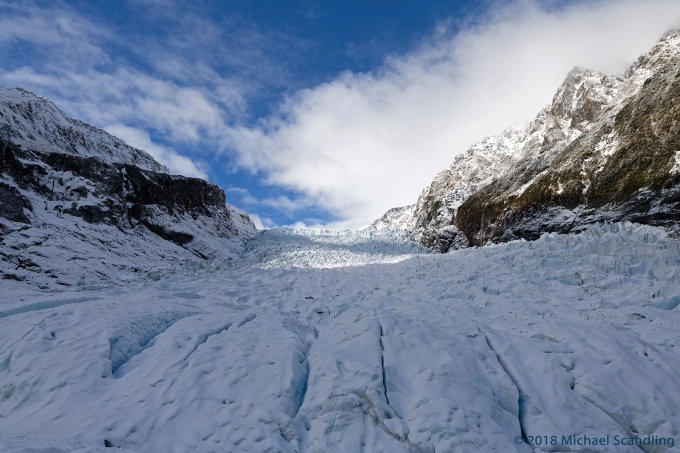
As with all things, cold is relative. The landscape above shows Fox Glacier on the South Island of New Zealand. That’s cold. Here in the San Francisco Bay Area, the mid-40s in the daytime is cold for most of us. But I do know cold: I grew up in western New York State, where cold is cold. Sub-zero cold. Quiet cold.
What got me thinking about cold was some recent blog posts by a writer-photographer, a photographer-haiku poet, a nature photographer, another nature photographer, an urban photographer, and a watercolorist. On a few of them I commented that I could hear the silence.
I have childhood memories of getting up in the morning after the first deep overnight snowfall. Complementing the quiet beauty of freshly fallen snow unblemished by human activity, there was an audible quiet. Not silence in a literal sense, but silence nonetheless. A quiet I could hear. A hush. A stillness. The quiet you hear when a blanket is over you. There is sound, but it’s soft. It soothes. When the cold is deftly shown visually, the quiet comes along with it. Check the links above and tell me you don’t hear it.
The first time I was struck by this silence in the visual arts was many years ago when my wife gave me a Japanese print as a gift for my birthday, which falls in a winter month.

Here are three horses running through a snowy meadow by a wood. Running horses make a noise. But not in this scene. Here you sense, at most, a faint breeze. As my wife and I admired it together, I said to her, “You can hear the silence.” She heard it too.
I’ve been pleasantly aware of it ever since.
Then came these blog posts, all within a few days of each other. As I said, they got me to thinking.
In the early-morning darkness I realized there are two cold silences. There is snow silence and there is ice silence. Soft snow silence comes from the fluffiness of a fresh snowfall. The fluffiness absorbs high frequencies. You hear a muted murmur. Ice silence comes from the long-wave flexibility of sheet ice absorbing low frequencies (a large sheet of ice will bend slightly) while the surface hardness reflects faint high frequencies. You hear a tranquil cold crinkling.
I found myself wishing I had cold silence images of my own to share, and it turns out that despite being a Northern California guy, I do. Listen to these.
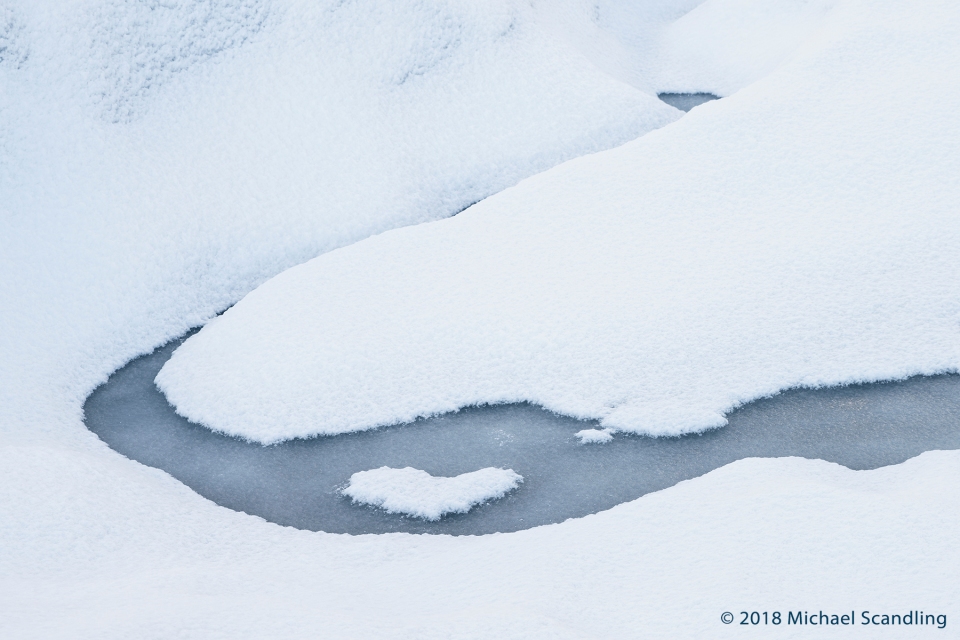
This one, a small rivulet on Fox Glacier, has snow silence. (Yes, Georgia—O’Keeffe—was on my mind as I composed the shot.) As I post-processed this photograph, I felt a soft chill.

This image, a slight abstraction of a shallow crevasse, has a soft snow silence and a hard ice silence. Between the two, I can barely hear a thing. As I worked on it, the freeze went to the bone.
I hope you heard them.
Thanks to the bloggers who inspired me. I don’t often get to experience the cold that some of them do. But I have my blessings: It’s 55 degrees and partly cloudy right now.
(Nikon D850; Tamron 24-70mm f/2.8 G2, Tamron 100-400 F/4.5-6.3 Di VC USD. RAW processing in DxO PhotoLab 2; final editing in Adobe Photoshop.)
February 17, 2019, San Joaquin River Delta; February 10, 2019, San Francisco Bay. I’m lucky to live in an area where White-tailed Kites are relatively common. Yesterday we went on a birding trip through the San Joaquin River Delta with naturalist David Wimpfheimer on a boat operated by Dolphin Charters. I recommend both. Along the way we saw about sixty species. One standout was this beautiful and cooperative white-tailed kite. He watched us as we slowed to watch him and then, bored with us, he took off. He flew out about two hundred feet and then wheeled around for what I’d like to think was a fly-by for the camera, but I know he was looking for lunch. If he’s anything like his cousin who lives by the San Francisco Bay, I’ll bet it was a good one.


Last weekend we were walking on the levees in the marsh area by the bay in Sunnyvale. The walk was ostensibly for exercise, but we brought cameras too. We always bring cameras. (The weight of the big lens makes for better exercise. That’s what I tell myself. Of course, there just might be birds . . .) The kite you see below was kiting — hovering — for more than three minutes. During that time, his position over the marsh didn’t vary by more than five feet as his eyes swept the ground. Then down he went. Lunchtime.

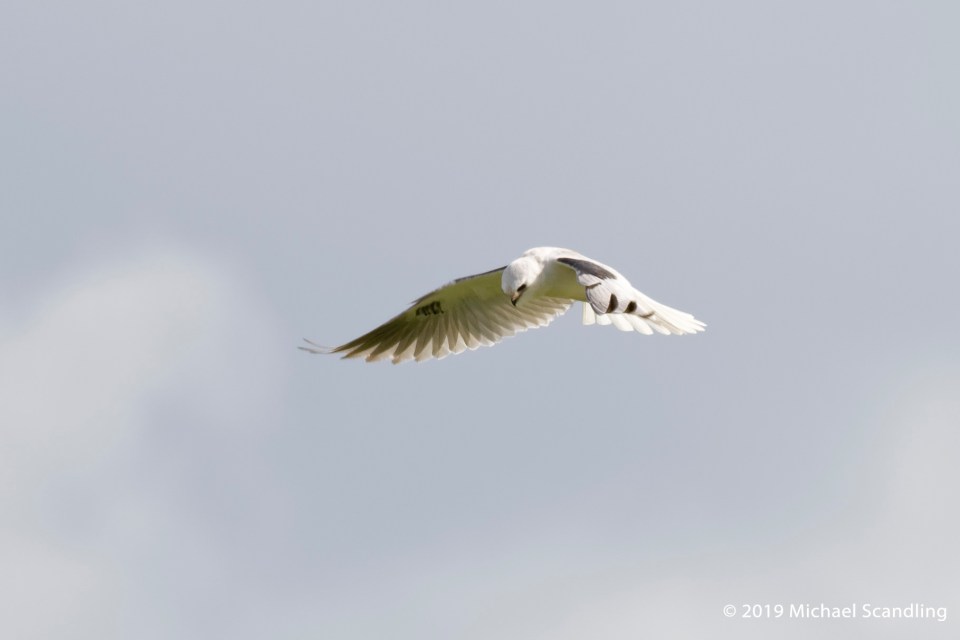
If anybody tells me to go fly a kite, I’ll tell them that these raptors do it better.
(Nikon D850; Nikon 200-500mm f/5.6E ED VR. RAW processing in DxO PhotoLab 2, final editing in Adobe Photoshop.)
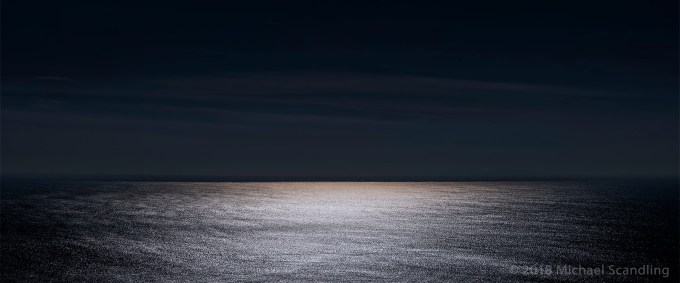
December 7 and 8, 2018, Point Reyes National Seashore. Horizons are beautiful in their simplicity. Engaging in their subtle complexity. Their moods are varied. They have endless color and texture possibilities. For all these reasons I never tire of them. But there’s another reason as well.
Horizons are calming. Soothing. Stabilizing. Horizons are therapeutic. Stand on a bluff looking outward over the sea for only a few minutes, and if you’re like most people you’ll feel both rested and invigorated. Gaze longer and a reassuring sense of stability will develop. The turbulence of life calms and a sense of order is restored. Stress dissolves. The space does that.
Space ceases to be just the horizon’s and becomes your own. The space is real. At sea level, the horizon is about three miles (almost five kilometers) away. When you stand at one hundred feet (thirty meters), as in the seascape above, the horizon is about twelve miles (almost twenty kilometers) away. That’s a lot of space to take virtual ownership of. Extend your line of sight and there’s even more space. From the vantage point of the shot at the top of this post, the nearest landfall would be somewhere in the Philippines. But if you extend your line of sight straight out and don’t follow the curvature of the Earth your gaze is measured in light-years.
Then there is stability. On a clear day, the horizon is faithfully the horizon. It’s not going anywhere. You can count on it, and in this world it’s good to have something you can count on. (On foggy days, the deal might be off — so if you’re feeling foggy yourself, the therapeutic value diminishes. Unless you get fascinated with the constant shift of patterns in the fog, in which case that’ll chase your blues away.)
Photographs of horizons can have similar effect, especially if they’re large.
Recently I’ve been shooting nearer shores. In this one, the other side of Tomales Bay is less than a mile away. It’s a composite of two intentional camera motion shots made with different rates of motion. The only other bit of post-processing was a bit of selective sharpening. The color is as it was on a moody December dusk.
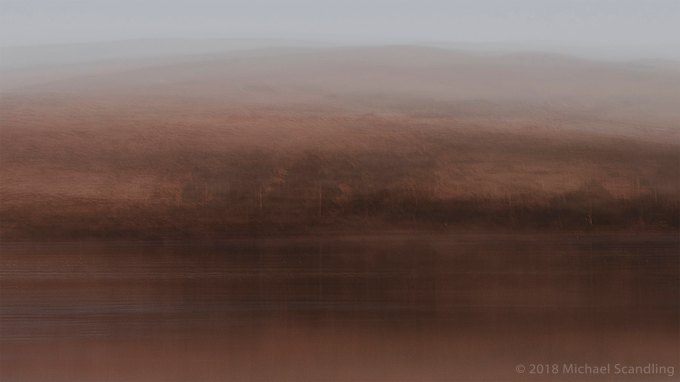
The next evening, we went out to the Chimney Rock trail in search of the setting of a crescent moon, but it turned out to be such a tiny sliver that the thin fog completely obscured it. There was a consolation prize, however: the alpenglow on cliffs on the far side of Drake’s Bay was soft and inviting. A long exposure and a twist made it ethereal.
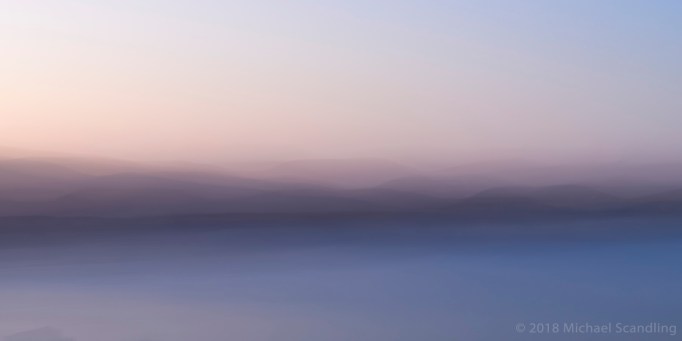
It seems the horizon doesn’t have to be that far away to be magic. . .
(Nikon D850; Tamron SP 24-70mm f/2.8 Di VC USD G2. RAW processing in DxO PhotoLab 2, editing in Adobe Photoshop)
More fine art photography at www.amagaphoto.com
June 14, 2011, the Tate Britain, London. If I had to pick one favorite artist, it would be J.M.W. Turner. I think of his work as the bridge between Romanticism and Impressionism and in my opinion he often outdid both. I find his later work, especially, to be transcendent.

Joseph Mallord William Turner
Norham Castle, Sunrise
c.1845
In June 2011, my wife, nephew, and I went to Europe to visit family, surf (one of us), hike, and absorb culture. The first stop was London and among the many museums we visited were both Tates. In the Tate Modern I bathed in Rothko. In the Tate Britain I basked in Turner.
Of course we saw all the famous Turners — which tend toward the Romantic — and while my eyes absorbed the glow, another sense was denied: it took tremendous willpower to resist touching the almost mystical brushwork. I was reverent. Motionless. But a bit of a draft caught my attention.
I followed it to a small gallery off to the side and there was the most memorable treasure of all: a generous selection of unfinished works whose swirling, twisting, billowing, multi-colored motion did things to time and space that can only be shown; never spoken. My nephew and I were the only two in the room. We sat in silence as the brushstrokes became vanes that seemed to move the air around us. But there was not a sound.

My wife captured the moment.
It seemed sacrilegious to photograph the strokes close-up, but I had to see and preserve them for later study of how he did it — so I did make a few clicks. Folly. I’m not Turner. Never will be. But I can admire.
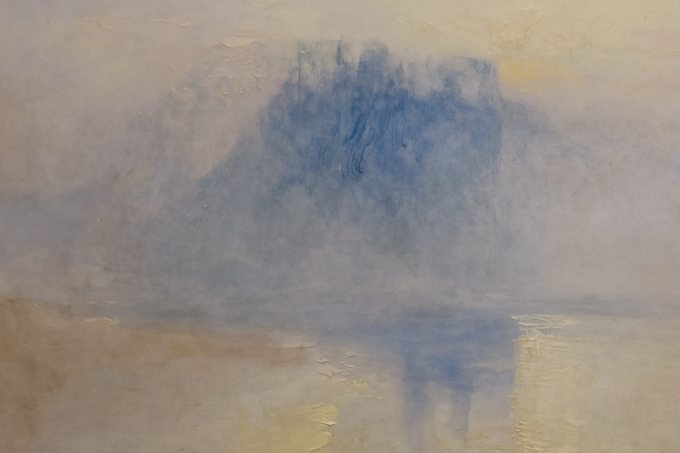
Norham Castle, Sunrise — Detail
September 6, 2018, McKinney Bay, Lake Tahoe. The post-sunset alpenglow was a perfect opportunity to shoot some intentional-camera-movement abstracts. Many were shot; few were chosen. Most were shot with a full 180-degree turn, but on this one I stopped halfway. An unfinished turn. A streak of light from the marina next door followed the sweep, providing a just a bit of counterpoint.

I was reminded of Turner and wondered what he would have done with a camera.
(Museum shots: Canon S95. Tahoe shot: Nikon D850; Tamron SP 24-70mm f/2.8 Di VC USD G2.)
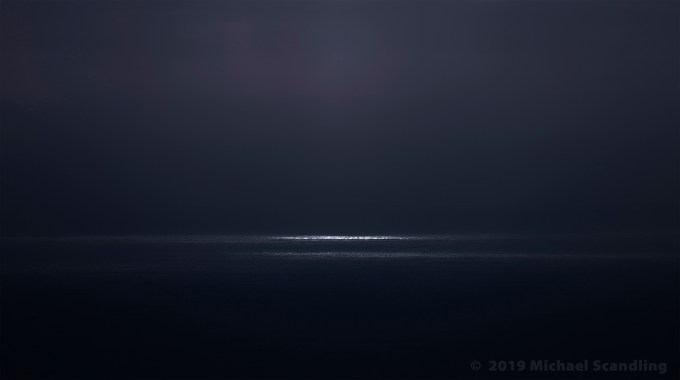
Scrape: To graze across or on something. The sunbeam scraped the sea.
Scrape: A difference of opinion or predicament. Is this image literal? Abstract? Impressionistic?
(Nikon D850; Nikon 200-500mm f/5.6 ED VR zoom.)
Gulls are everywhere. Gulls are a dime a dozen. They’re not special. They’re not particularly beautiful. They’re not evocative. Gulls are a waste of time. I don’t shoot gulls.
Yeah. Right.
The only statement above that’s even partially true is the first one: they do seem to be almost everywhere.
Meet Spot. Spot is a Western Gull of a certain age who hangs out in the vicinity of Tomalas Bay in California. Spot was given his name by the owner of a vacation house we rented on a recent weekend.

The information book in the house said that Spot has been hanging around for many years, charming guests out of treats. Years? We looked it up: Western Gulls commonly live fifteen years and can live up to twenty-five years. Clearly Spot deserved respect. And a treat.
Since gulls are scavengers, we figured a few oyster crackers wouldn’t hurt. He readily agreed, as my wife made the offering.

A few weeks before, I was shooting brown pelicans near Monterey when this gorgeous gull swept by (sweeping my attention as well) and did a dramatic fly-by in front of a breaking wave. Backlit. Spectacular.

A little more than six months earlier we were marveling at Fur Seals on the Otago Peninsula on the South Island of New Zealand when this graceful Black-Backed Gull glided by, framed by creamy clouds. Yeah. Right. Gulls aren’t evocative . . .

(Nikon D850, Nikon D500. Tamron 24-70mm f/2.8 G2, Tamron 100-400 F/4.5-6.3 Di VC USD, Nikon 200-500mm f/5.6 ED VR zoom.)

January 17, 2019, Point Reyes National Seashore. There he was. Coyote. There I was. Human. As we warily watched each other it occurred to me that each of us thinks the other is wild, unpredictable, and dangerous. We stared. I got my shots. He walked off—impatient to get on with life, but unscathed. I thought he was handsome. I don’t know what he thought.
(Nikon D500, Tamron 100-400 f/4.5-6.3 Di VC USD)
April 10, 2015, Hurricane Point, Big Sur Coast. My dog and I decided that conditions were right for a ride down the coast. Travels with Chewy. And Nikon.
We made it as far south as Hurricane Point. Crystal clear. The horizon went halfway to Hawaii. And so did the sunbeam. Chewy and I looked out to sea. He turned and looked to me as if to say, “this is special.” A sea dog. A wise one.
Aided by a neutral density filter, I exposed to preserve the highlights. Back home, post-processing brought out the wispy clouds. I cropped in homage to Rothko.

Fast-forward to earlier this week. I was looking through Mark Rothko paintings while preparing the last blog post and this jumped out at me. I had no idea that this particular painting existed.
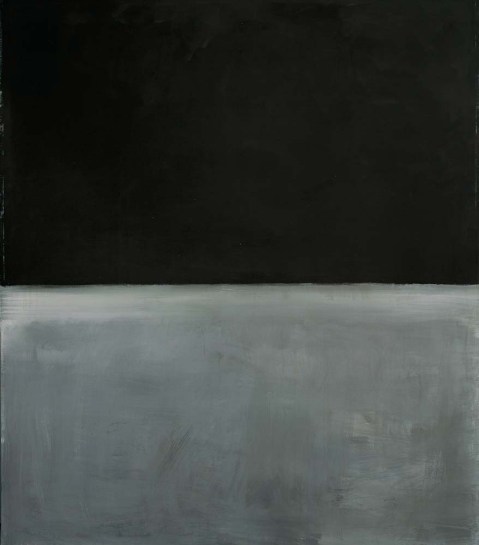
Mark Rothko, Untitled (Black on Grey), 1970, National Gallery of Art, Washington, D.C.
That muse gets around.
(Nikon D750,Nikon 28-300mm f/3.5-5.6G ED VR)

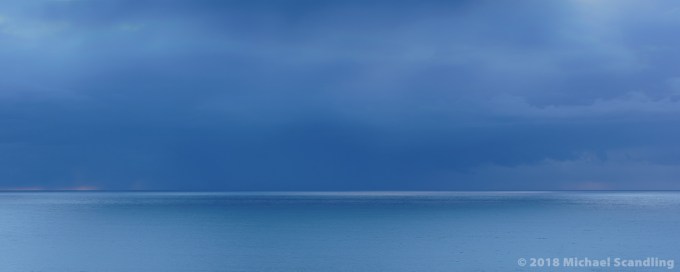
This is one of my favorite seascape horizon photographs: How Blue Can You Get?
Some photos present themselves to me on a platter. Some are made. This is both—although in this case the platter was more of a blue plate special.
February 7, 2013, Sonoma County Coast. I was driving up the coast with my wife, looking forward to a winter weekend on the bluffs. The driver in me was trying to beat an impending storm. The photographer in me was hoping we’d hit it square on. The photographer won. Just north of Jenner it was almost upon us, majestically rolling in. I stopped at the next turnout.
All my camera gear was securely (and utterly inconveniently) packed away, so I grabbed my small but very capable Sony RX100 and forced the door open into the wind. I stood on the side of the road and watched the storm approach. While the gusts were increasing in strength, the clouds were like floating castles—getting bigger by the minute. And the whole scene was . . . blue. I made several shots as the storm front grew in the sky and dashed back to the car just as fat raindrops began to pelt me in earnest. I asked my wife, “did you see that?!” She confirmed that I was not hallucinating.
When we finished the drive and I unloaded the photos into my laptop (which had a meticulously color-calibrated screen), there was the scene. Blue. Not a camera color-balance error either. It was blue.
As I explored the shots at various magnifications and savored the possibilities of the photograph I was going to make out of this, I was visited by the muse of Mark Rothko who, characteristically, spoke only a few words—but the right ones. I extracted just the heart of the scene. The simple essence. Balance and texture. Voila.
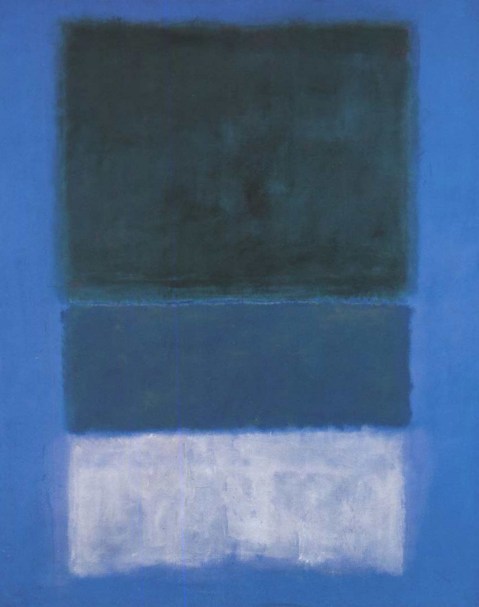
No. 14 White and Greens in Blue — Mark Rothko
Some time later when I decided to title my photos I was visited by a very different muse. This time it was B.B. King singing, How Blue Can You Get? The original lyrics (written in 1949 by Leonard and Jane Feather) transformed into new words where the ocean sings to the cloud:
I gave you a billion raindrops
And now you want to give them back.
There was the title. In that state it lived for several years, inspired by Rothko and named after a blues song. But there was still that unanswered question.
In mid-2018 I took another look at the original scene. This time I was inspired by the majesty of the panorama. I made a new version. Rothko lives in this one as well, joined by maybe just a tiny breath of Turner and O’Keeffe. Now the question is finally answered. How Blue Can You Get? This Blue.
 AMAGA Photography Blog